
What is the Model Context Protocol (MCP)?
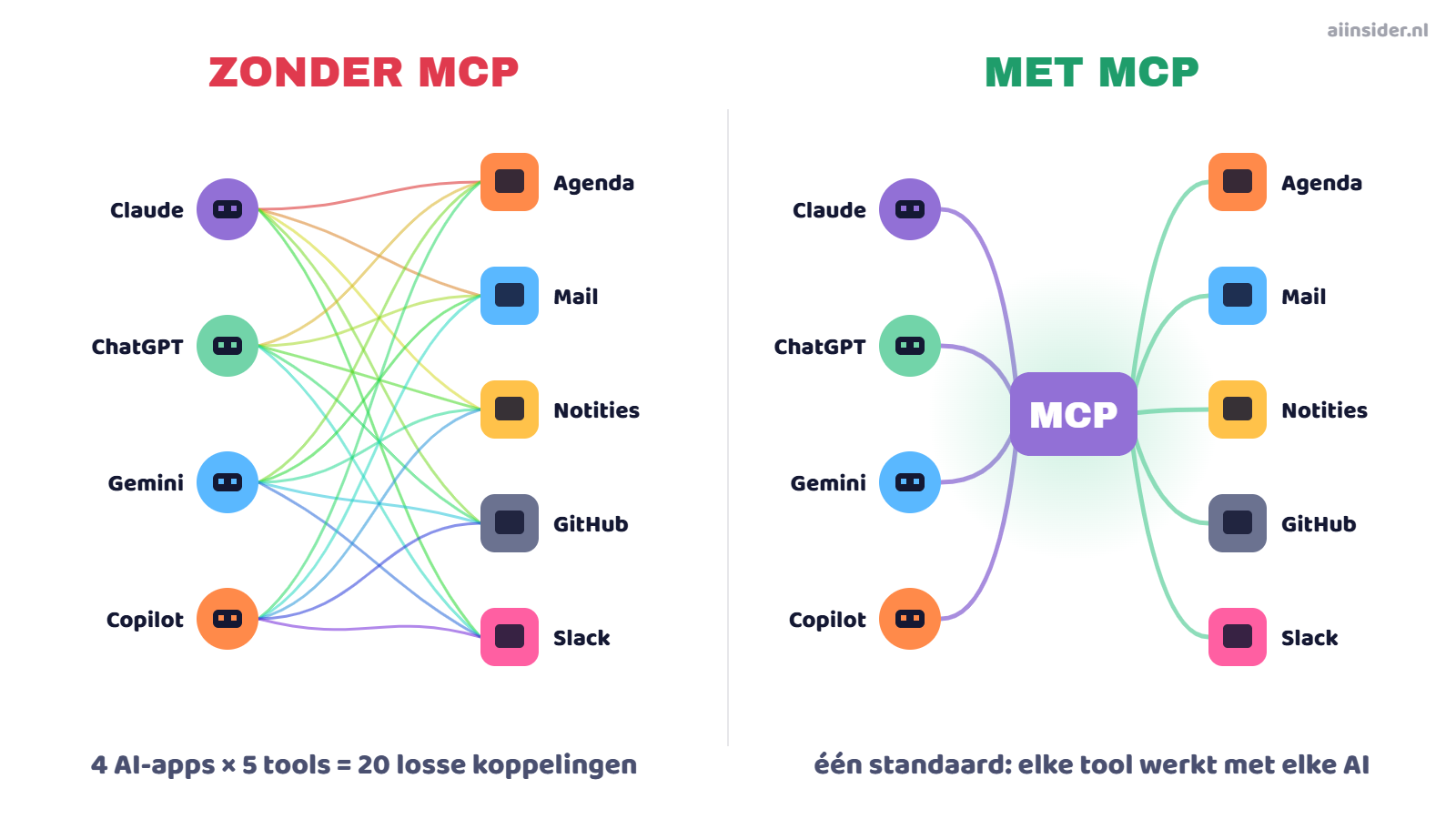
MCP, or Model Context Protocol, is the key to the recent capabilities that allow AI assistants access to calendars, email, and files. This protocol, introduced by Anthropic at the end of 2024, provides a standardized way for AI to communicate with various software applications. Key players such as OpenAI, Google, and Microsoft have already joined, and the protocol is crucial for organizations integrating AI with customer or business data, especially in light of the GDPR regulations in the Netherlands.
The Model Context Protocol acts as a universal connection for AI systems, enabling them to interact with various software, similar to how a USB-C port functions for different devices. Developers only need to create an MCP server once; all AI applications that support MCP can then utilize it. This reduces the need for separate connections for each combination of AI and software, significantly increasing efficiency.
Before MCP was introduced, AI language models, such as ChatGPT and Claude, were limited in their functionality and could not independently access calendars or documents. These systems had to establish separate connections for every combination of AI app and software, which was extremely time-consuming and error-prone. With MCP, AI can easily communicate with different servers, drastically reducing the necessary connections.
MCP is now in use across a variety of platforms, including GitHub, Figma, and Slack, allowing developers to leverage AI for various tasks, from searching code to operating websites. For average users, MCP is often hidden under labels such as 'connections' or 'connectors'. However, the implementation of this protocol also raises concerns about security; good applications always request permission before making any changes or deletions. Additionally, it is important to carefully consider what information you provide to the AI to avoid risks of misleading information from external texts.
Read the full article from AI Insider.
Gerelateerde artikelen

Planet Discovered from Dead Star Material
Scientists have recently made a remarkable discovery: a planet that is believed to have formed from the material of a dead star. This scientific research may mark the identification of a new class of...

Tech Festival
07 October 2026

Healthleap raises $38 million for AI application
Healthleap, an innovative technology company focused on healthcare, recently raised $38 million in funding. This amount includes an $8 million seed round, coordinated by Sequoia Capital and First Roun...
Tech Festival
07 October 2026
Bloom raises $3.6M to become the 'Alibaba' of American manufacturing
The American startup Bloom has recently raised $3.6 million in funding to strengthen its position in the manufacturing sector. The company, originally founded in Detroit, has expanded its operations f...
Tech Festival
07 October 2026